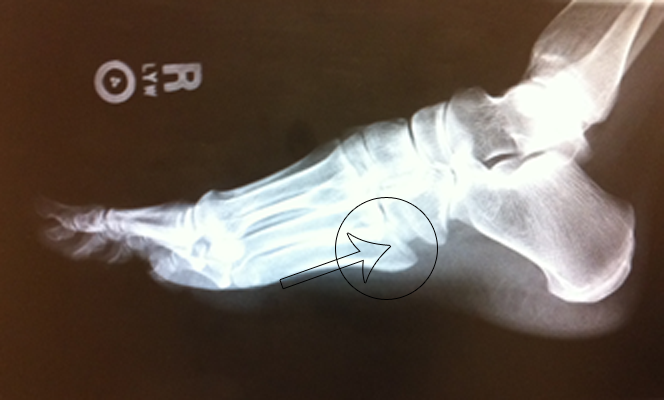
See that small, shadowy line? That little bit of nothing is what's causing me so much trouble.
It seems like there’s no time like the present to talk about broken bones, what with having one of my own. This is my first break, so I’ve spent a lot of time trolling the internet for information. Of course, this information varies between, “listen to your doctor and you’ll be fine,” and “you’ll spend the rest of your life as a crippled, arthritic mess.” I prefer to believe the former, thank you very much.
Anyone who has broken the wishbone in their holiday turkey knows the basic principle: if you put too much strain on a bone, eventually it will snap in two.
There are three kinds of breaks:
- Simple Fracture: A single break where the bone remains largely in place.
- Compound (or Open) Fracture: A break where the bone pokes through the skin.
- Stress Fracture: A hairline crack in the bone that comes from repeated or prolonged force.
I initially assumed that my break was the result of a stress fracture gone wild. After all, wouldn’t it make sense that all of that running would weaken it? But as it turns out, my bones showed no sign of stress. My break — at the proximal end of the 5th metatarsal, as you can see in my X-ray — was just bad luck. When I tripped, my foot rolled; while the rest of my foot kept going, the tendon that attaches to that point held strong, and just like the turkey wishbone… snap.
Symptoms of a broken bone include:
- A visibly out-of-place or misshapen limb or joint
- Swelling, bruising, or bleeding
- Intense pain
- Numbness and tingling
- Broken skin with bone protruding
- Limited mobility or inability to move a limb
There is a great explanation of how bones heal on Discovery Health. I’ll give a quick recap here:
- When you break the bone, you sever blood vessels; this explains my bruising. The blood forms a clot called a fracture hematoma, which not only stabilizes the bone, but helps to remove dead and damaged tissue while directing all of the blood flow to the parts that need to be repaired.
- Within days, the hematoma begins to toughen and create a soft callus that begins to produce collagen, the major protein in bone and connective tissue.
- In the next stage, the body produces bone cells, transforming the callus into a bone callus. This forms a protective shell and gives the bone time to heal.
- Over the course of several months, the bone begins to gradually remodel itself. The bone callus gradually fades as the bone returns to its original shape. Circulation improves and calcium and phosphorous help to strengthen the new bone.
With any luck, my foot will be weight-bearing again in November!
Tags: bones, break, foot, fracture, metatarsal, recovery, simple fracture
 Cooking
 Fitness
 Health
I sustained a stress fracture while training for a half marathon…on the 4th day of training.
Did I mention some people are not meant to run? (Me. Not you.)